Sunday, October 15, 2017

Hyundai Kona Electric: Two Battery Options, Up To 210-Mile Range

15 hours ago by Steven Loveday

Hyundai Kona

2018 Hyundai Kona

More details emerge about the Hyundai Kona EV.

Korean automakers, Kia and Hyundai, have significantly upped their game over the past few years. Both also seem to have a solid idea of what consumers want. SUVs, Crossovers, spacious compact cars, healthy standard and available feature lists, tons of tech including active safety suites, industry-leading warranties, and all at a reasonable price point.

Hyundai already makes the Santa Fe, Sante Fe Sport, and the Tucson, but hasn't yet released a subcompact crossover.

The Hyundai Kona will follow in the footsteps of the Kia Niro, which is trailblazing the segment to electrification for the company. The Niro is offered both as a traditional hybrid, but also now a plug-in hybrid (making its US debut this month after being released in Europe).  Additionally, a pure-electric Kia Niro is set to hit markets in 2018.

The Hyundai Kona EV (patterned after the Niro) will then also be Hyundai's first fully electric utility model.

Initial reports revealed that the Kona would have a 40 kWh or 50 kWh battery. Now, information also points to a second battery option.

The long-range Kona will come with a 64 kWh battery and a range exceeding that of the base 2018 Nissan LEAF at 150 miles (but similar to the longer range 2019 LEAF with a 60 kWh battery and ~225 miles of range arriving later next year).  In other words, much more like that of the entry level Tesla Model 3, and not too far behind the Chevrolet Bolt EV, with the Kona EV estimated at about 210 miles per charge. The Kona with the larger battery, should still price out at, or just under $40,000 when it hits the U.S. market next year (as a 2019 model year vehicle).

Interestingly, Hyundai is using LG Chem as one of its powertrain suppliers. According to Gas2, the Kona is speculated to feature the same motor used in the Bolt (~204 hp).  Also of note, the Bolt uses a 60 kWh LG Chem battery pack, but it appears that the Kona's pack will be a touch bigger (or perhaps GM is just promoting the usable capacity over the net capacity). We shall ultimately see when the pure-electric subcompact SUV's specs are released closer to its launch.

Information from Gas2 points to the Kona having a full suite of active safety technology and upgraded charging, which could work with 150 kW chargers.

Source: Gas2

Tags: chevrolet bolt, featured, hyundai, Hyundai Kona Electric, hyundai kona ev, kia, kia niro, Kona, Kona Electric, LG Chem

Get Updates

Subscribe to our e-mail newsletter to receive updates.


Source: Hyundai Kona Electric: Two Battery Options, Up To 210-Mile Range

Saturday, October 14, 2017

Electric cars: China’s highly charged power play

China has numerous reasons for hating the combustion engine, and a huge incentive to hasten its demise. They are dirty, accounting for what the government says is about 30 per cent of the country's choking air pollution; contribute massively to its oil imports, which Beijing sees as a major strategic vulnerability; and highlight a shortcoming that has been a chronic flaw in the domestic car industry — China is bad at manufacturing them.

Last month Beijing gave the global movement to eradicate the combustion engine a sizeable boost. Alongside a number of European countries that have proposed bans on traditional fuel vehicles to be brought in between 2025 and 2040, Beijing has said it is studying the timing of a similar move against petrol and diesel cars.

Welcomed by environmentalists, the move also plays into the vision of state planners who see the electric vehicle market as an industry it can compete in, or even dominate globally.

The government reinforced its position in September when it announced a system of steadily increasing quotas that will reward carmakers for producing ever more battery-powered vehicles starting in 2019, while forcing them to buy EV "credits" from other producers for every conventional car they make.

As the world's largest and most profitable auto market, China has huge leverage over the industry and is not afraid to use it. It boasts a central planning mechanism designed to subordinate all other considerations — like profitability and consumer tastes — to government fiat. It has poured billions of dollars into subsidies and state investment in the sector.

Those interventions mean China is already the world's largest maker of electric vehicles. Last year it sold 507,000, including buses and commercial vehicles, according to the China Association of Automobile Manufacturers, around 45 per cent of the world's total. Yet Beijing has set a target to manufacture 7m battery cars and hybrid vehicles by 2025.

"They can order charging stations set up all over China, dictate driving and licence plate restrictions in major cities," says one western car industry executive in Beijing adding that these are measures western governments would be hard pressed to emulate.

Picking winning industries has been a tried and tested strategy for rising Asian economies since the 1960s, and China's efforts to jump ahead in electric vehicles resonate with the policy successes of Japan and South Korea. Electric vehicles are just one plank of Beijing's ambitious policy known as "Made In China 2025", which seeks to transform the country from a low-cost manufacturer to a high-tech power dominant in 10 advanced industries by the middle of the next decade — including robotics, semiconductors, and electric vehicles.

A sign directs traffic to a public electric vehicle charging station in Beijing. China has set a target to manufacture 7m battery cars and hybrids by 2025 © Bloomberg

If the environmental and economic motivations are clear, Beijing also sees a competitive edge to exploit: while it has long lagged behind in the technology of combustion engines, it boasts two of the top-five lithium battery makers in the world, CATL and BYD. 

"If the engine and power train of the car is replaced with a simple battery, the global car majors could lose control of car [production]," says Yale Zhang of Automotive Foresight, a Shanghai consultancy. "It becomes a bunch of parts that can be sourced from anyone."

Cars could, in short, follow smartphones and computers in becoming an industry driven by commodified hardware, much of which is now mass produced in southern China. At the moment foreign rivals have a lock on technology for hybrids and combustion engine power trains, but many Chinese companies have an edge in patents for battery-powered technology. Goldman Sachs estimates that by 2030 China will account for 60 per cent of sales of all new energy vehicles (NEVs) in the world.

"They want to create an industry which meets their national security needs [by reducing oil imports]," says the car industry executive, "and which they can dominate".

A pedestrian covers up against pollution in Beijing. China says combustion engine vehicles account for about 30 per cent of the country's air pollution © Bloomberg

Its recent record of centrally planned innovation has been mixed, however, with projects often inspired more by political necessities than economic demand. Investments in high-speed rail have been largely successful, if costly, while an effort to build traffic-straddling electric buses failed spectacularly this year after accusations of fraud that saw 32 people detained.

Many of Beijing's efforts at directing the market have resulted in overcapacity, as entrepreneurs pile in to chase government subsides. That has caused worldwide gluts in everything from steel to solar panels. Some fear electric vehicles may be next: more than 200 companies have, in recent years, announced plans to manufacture them. Yet questions remain over how long it will take — and how much will have to be spent — before the industry is viable.

It means that, for now, the market for battery-powered cars and hybrids in China is stubbornly reliant on subsidies to stay competitive. When these subsidies were lowered by 20 per cent in January, demand plummeted. Sales of the BYD E6, the Shenzhen-based group's best-performing electric model in 2016, fell 62 per cent in the first six months of 2017 compared with the same period a year earlier. Overall, BYD sales of battery cars and hybrids fell 20 per cent between January and June, in the wake of the subsidy cut.

"The NEVs still cannot compete with combustion engines if we do not factor in favourable policies or subsidies," Feng Xingya, vice-chairman of Guangzhou Automobile Group, told a car forum in Chongqing in June.

Michael Pettis, professor at Peking University's Guanghua School of Management, says: "China has a pretty bad record of losing money on projects that are ultimately not sustainable." Instead the innovation success stories, he says, have come in the private sector. Internet retail and social networking by the likes of Alibaba and Tencent "were things that happened behind people's backs", effectively out of the view of the state, he adds.

Total state investment, including subsidies, in the sector is huge. Beijing expects spending to top Rmb400bn ($60.7bn) — roughly the gross domestic product of Uzbekistan — between 2015 and 2020 on new energy vehicle subsidies, from both central and regional government, which will then be phased out by 2021. This translates to about Rmb100,000 ($15,000) per vehicle sold last year.

The role of the state is even more pronounced when it comes to the national grid's Rmb25bn investment in a network of charging stations. There are already 171,000 nationwide, according to Xinhua, China's official news agency, but that number is expected to increase dramatically over the next three years amid complaints that it is still difficult to find a charging station. In the US there are just 44,000 charging outlets and 16,000 electric stations, according to the US energy department. 

However, the push for electric cars is likely to test the limits of what China's central planning apparatus can do, with battery technology said to still lag behind the ambitions of state planners. Experts say the batteries are too heavy and too expensive, meaning that vehicles will be unappealing to consumers without continued subsidies.

A vehicle sits in a testing lab at the BYD headquarters in Shenzhen. The Chinese company is also one of the top-five lithium battery makers in the world © Bloomberg

Mr Zhang says the power density of existing batteries is about half of what it needs to be to sustain ranges of 400km, which is what many consumers want. But counting on battery technology to edge ahead of petrol, which is itself becoming more efficient, depends on several variables.

"Without a breakthrough in technology it's hard to see how NEVs will really be popular. The problem is there is no Moore's law for batteries," he says, referring to the exponential growth of the power of computer processors.

Mary Barra, GM chief executive, last month called for less state diktat and more attention to market forces in determining China's electric vehicle policy. Speaking in Shanghai, she said: "I think it works best when, instead of mandating, customers are choosing the technology that meets their needs."

Many economists and industry heads are counselling China to wait until the market and battery technology catch up with their ambitions, but Beijing's policymakers insist that a generous helping of state intervention in the market is what is needed as a catalyst to make the industry sustainable in the first place.

Under the scheme the carmakers will earn credits for every electric or hybrid vehicle produced, and will be charged credits for every traditional fuel car they make. Rushing to comply with the plan, VW, GM, Ford and others have this year announced joint ventures, mainly with smaller Chinese counterparts.

One expert says the cars they are producing are mainly very small and low quality, aiming to simply meet quotas. "It's a very short-term approach — they want to get the credit first, to help them to financially maximise their benefit through the policy," says Xu Qian of the Shanghai office of AlixPartners, the US management consultancy.

One industry lobbyist in Beijing says the quota scheme is a way to transfer the burden of subsidies to the private sector to replace those phased out by the state. 

An employee works on an electric car at the Beijing Electric Vehicle company © Reuters

The biggest obstacle seems to be a new factor in state planners' calculations: consumers who seem to be in no rush to follow the government's lead.

Jochem Heizmann, VW China's chief executive, said in April that selling large volumes of EVs would not be easy, but manageable, adding that selling to car-sharing and ride-hailing fleets would be a large part of the business. "It's one thing to design and produce this offer," he said, "the other thing is that customers have to buy."

While China offers the most generous purchase incentives of any country aside from Norway, this has not translated into mass adoption. In the Scandinavian country hybrids were 24 per cent and electric vehicles 15 per cent of new purchases in 2016. Meanwhile in China last year they made up just 1.32 per cent. In many places combustion engines have made a stealthy comeback, says Jeff Cai of JD Power, which publishes consumer data for the auto industry. Drivers are finding that pure battery cars are small and cramped, and are heading either back to combustion engines, or to plug-in hybrids he said.

Recommended

Seven out of 10 EVs and hybrids are sold in just six Chinese cities, which restrict licence plates for combustion engines, according to Fitch Ratings. In Beijing, licences for combustion engine vehicles are available only by lottery while in Shanghai they can cost up to Rmb80,000 and have long waiting times. Mr Xu says NEVs are mainly bought by people who want a licence plate rather than an electric vehicle.

In the heyday of central planning, China's government had a freer hand to ignore what consumers wanted to buy, and what manufacturers wanted to make. Today things are different. A new middle class wants a roomier, more comfortable ride. The reality is that unless, or until, Chinese customers want to drive them, the market for new energy vehicles may never take off.

Additional reporting by Sherry Fei Ju in Beijing and Richard Milne in Oslo

The environmental case for new energy vehicles is not straightforward. Compared with petrol and diesel, making battery-powered cars and powering them with coal-fired electricity can be just as big a pollution problem, if not bigger — it just depends how it is calculated. 

With around 75 per cent of China's electricity produced by coal and battery production very energy intensive, the production of NEVs in China actually create 50 per cent more greenhouse gas emissions than that of internal combustion engine cars, according to a May article in Applied Energy by five Tsinghua University scientists. 

However, according to a study by MIT from 2007, comparing pollution from smokestacks and that from exhaust pipes is not clear cut, because cars emit fumes where people live and work. One tonne of dangerous (PM2.5) particle emissions from cars is about 11 times as harmful as one tonne from power plant stacks, in terms of total population exposure and health impacts, according to the MIT study. 

Taking into account the battery production process and coal-fired electric power, Lauri Myllyvirta of Greenpeace in Beijing, says NEVs may well pollute more than combustion engine vehicles in China, as both CO2 emissions and PM2.5 levels per kilometre driven are similar. 

But Mr Myllyvirta says this will change — 75 per cent of China's electric power is coal generated, but that could fall to less than 50 per cent by 2030. He adds that it will also be easier to regulate emissions at power plants and make them cleaner; emissions from electric power generation are expected to fall by a third by 2030 because of the changing fuel mix. This does not include improved emissions controls at power plants, which are expected to cut pollution rates by more than half in the same timeframe. 

This article has been amended to reflect that it is the production of NEVs in China that produces more emissions


Source: Electric cars: China's highly charged power play

Friday, October 13, 2017

Norway’s electric car owners face ‘Tesla tax’

A Tesla Model X, which could cost up to $10,500 more in Norway if the tax is imposed © Bloomberg

Norway is proposing a "Tesla tax" that would hit owners of the heaviest electric cars in a move that critics say will undermine the Scandinavian country's standing as a pioneer of zero-emission vehicles.

Sales of electric cars and hybrids accounted for 60 per cent of new vehicle sales in Norway last month, fuelled by extensive subsidies in taxes, tolls and parking fees.

But the centre-right minority government in Oslo is now proposing a one-off tax on all electric cars that weigh more than two tonnes — something that at present would predominantly target Teslas and potentially add up to NKr82,800 ($10,500) to the cost of buying one.

Essential stories related to this article

Tuesday, 19 September, 2017

"This is a tax bomb. This is gambling with the whole electric vehicle market. It is a bad signal to send and will affect consumers," Christina Bu, general secretary of the Norwegian Electric Vehicle Association, told the Financial Times.

Norway has been hugely successful in introducing electric cars and aims to sell only zero-emission new vehicles by 2025. But critics argue that their popularity is mostly down to an extremely generous set of subsidies that can cut the price of the most expensive Teslas by about NKr450,000.

When and how to withdraw those subsidies has sparked a huge political debate. Some Norwegian politicians point out that many of the early adopters of electric cars were rich households buying Teslas. Bus drivers in the richest parts of Oslo complain that bus lanes are clogged with electric cars, which are permitted to use them.

Before the tax proposal on Thursday, Andreas Halse, environmental spokesman in Oslo for the opposition Labour party, said although electric cars generated no emissions they contributed significantly to congestion in the capital as well as damaging roads because of their weight. "It is not just about emissions; there are other considerations, too, such as the use of cars versus public transport," he added.

The new tax proposals would add at least NKr36,000 and as much as NKr82,800 to the cost of the Tesla Model X, a sport utility vehicle popular in Norway because of its ability to tow trailers, a feature appreciated by families who own mountain cabins.

Ms Bu said that despite the success of electric vehicles, the market was still fragile, pointing to a significant fall in sales in neighbouring Denmark when some tax advantages were withdrawn. "It's too early. Nobody is saying we are never going to tax electric vehicles. But the government had promised to keep the regime the same until 2020," she added.

The proposal is likely to face fierce resistance in parliament with some of the minority government's traditional allies already voicing criticism.

The electric car tax was part of the 2018 budget proposals in which the government outlined plans to use a record sum from its sovereign wealth fund, earmarking NKr231bn ($29bn) from its oil fund, about 2.9 per cent of assets.


Source: Norway's electric car owners face 'Tesla tax'

Thursday, October 12, 2017

Electric Vehicles Are Here. Now We Need to Figure Out How to Charge Them

In the century since the dawn of the mass-market car, more than 100,000 gas stations have popped up along the country's 4 million miles of roads and highways--and a stop to refuel became a crucial part of the quintessential U.S. road trip.

But the heyday of the gas station as a place to refuel is probably drawing to a close. Analysts project that sales of electric vehicles will outnumber sales of gas-powered cars by midcentury. That means a wholesale rethinking of the infrastructure that consumers use to charge their batteries

Powering that electric-car fleet will require a dramatic increase in public charging stations from the 16,000 active today--and fast. How many will be needed? That's a bit unclear, but a good estimate from the Department of Energy (DOE) is four plugs for every 100 plug-in electric vehicles. The number of electric vehicles sold annually--including both plug-in hybrids and fully electric cars--is expected to grow from around 160,000 in 2016 to 1.5 million by 2030, assuming current federal tax incentives remain in place, according to the Energy Information Administration.

Less clear is who, exactly, is responsible for creating charging stations. "The question is up in the air," says John Heywood, a professor emeritus of engineering at MIT who has studied electric vehicles. "Questions need to be answered before we sort things out."

Automakers, power companies, third-party charging companies and federal, state and local governments may all have a vested interest in electric-vehicle infrastructure. That does not mean any of them are rushing to build them.

That's partly because, at the moment, charging stations remain largely unprofitable. There is little incentive for private charging companies to invest without a guarantor. So automakers and governments have stepped in, working with charging companies on their own piecemeal initiatives.

Charging stations are popping up in parking garages and public spaces. Tesla offers its drivers chargers along its own charging corridor, providing coast-to-coast driving access. BMW and Nissan have joined together to fund their own high-powered charging stations. And Volkswagen committed $2 billion to developing charging points in a settlement over its fraudulent diesel emissions scheme.

States from California to Connecticut have also committed to the effort, offering various grants and incentives to companies building charging points. This month several Western governors from a group that includes Colorado, Utah and Wyoming laid out plans for 5,000 miles of charging stations.

These efforts will rapidly expand the ability to charge on the go, but most remain in early days, leaving consumers to fare largely for themselves. As a result, more than 85% of charging happens at home, according to DOE. That solution is convenient for suburban drivers who can easily power up in a home garage but inaccessible for urban dwellers and long-distance commuters. "If you buy a battery electric vehicle, you need to buy a home recharger," says Heywood. "Well, that implies you have a home."

Industry analysts are betting that tech advances will unlock the golden age of charging. Most drivers today charge at home using a regular outlet, but DC charging can do the same job in a fraction of the time and is growing fast in popularity on roadsides. "A lot of early adopters would have been reluctant without the chargers at home," says Graham Evans, an auto-technology analyst at the market-research firm IHS Markit. "The next wave will see the chargers around."

Analysts expect the option to expand even further as the time for a long-distance charge declines to around 10 to 15 minutes. That's a bit longer than it takes to fill a tank. But on a road trip, between bathroom breaks and snack selection, not necessarily a delay.


Source: Electric Vehicles Are Here. Now We Need to Figure Out How to Charge Them

Wednesday, October 11, 2017

Charging Infrastructure Is a $2.7 Trillion Barrier to Electric Cars

That's enough to have a car drive fully autonomously, according to the chipmaker. The new device, announced by Nvidia founder and CEO Jensen Huang at an event today in Munich, is the latest generation of its DrivePX on-board car computers. Called Pegasus,… Read more

That's enough to have a car drive fully autonomously, according to the chipmaker. The new device, announced by Nvidia founder and CEO Jensen Huang at an event today in Munich, is the latest generation of its DrivePX on-board car computers. Called Pegasus, the device is 13 times faster than the previous iteration, which has so far been used by the likes of Audi, Tesla, and Volvo to provide semi-autonomous driving capabilities in their vehicles.

"In the old world, the more powerful your engine, the smoother your ride will be," Huang said during the announcement. "In the future, the more computational performance you have, the smoother your ride will be." And with this new piece of hardware, he's certainly trying his best to provide it.

Nvidia, which is one of our 50 Smartest Companies of 2017, says that the device is only about the size of a license plate. But it has enough power to process data from up to 16 sensors, detect objects, find the car's place in the world, plan a path, and control the vehicles itself. Oh, and it will also update centrally stored high-definition maps at the same time—all with some resources to spare.

It's worth noting that Nvidia isn't the only horse in this race. Intel recently announced that it provides all the computing power inside Waymo's autonomous cars, though it's been less forthcoming about the details of its hardware performance.


Source: Charging Infrastructure Is a $2.7 Trillion Barrier to Electric Cars

Tuesday, October 10, 2017

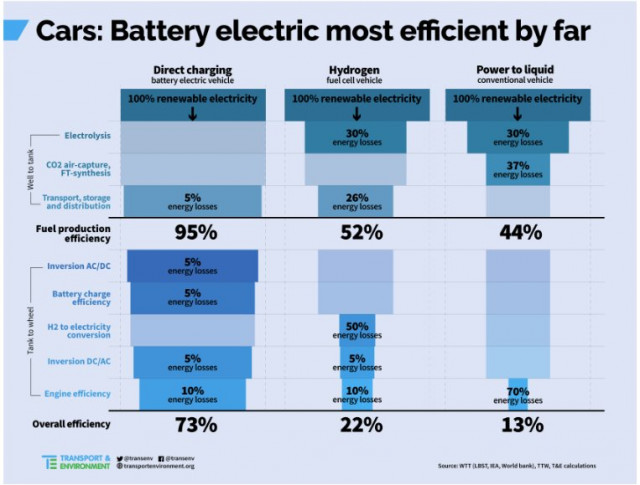
Electric cars win on energy efficiency vs hydrogen, gasoline, diesel: analysis

If you want to drive the absolute cleanest car possible – and if you're reading this site, we're willing to wager that you do – then you need to calculate the total well-to-wheels energy use of the car and everything you put into its tank or battery.

When it comes to comparing types of vehicles – hydrogen, standard gasoline and diesel, or battery electric – then a full accounting of the averages reveals that electric cars are the total efficiency winners.

At least, they are in a new study from the UK-based Transport & Environment.

DON'T MISS: Electric cars are cleaner than hybrids

The results are not even close.

Starting with all renewable energy for either charging or to process the gasoline or hydrogen, all-electric vehicles managing an overall efficiency rating of 73 percent, compared to 22 percent for hydrogen fuel cell vehicles, and just 13 percent for standard fossil fuel vehicles using gasoline made with the Fischer Tropsch process.

Of course, there are many details that need to be picked apart here.

For example, T&E says that fossil fuel vehicles lose 70 percent of the energy in their sloshing tanks because of inefficient engines.

DON'T MISS: Two words the Trump Administration can't say: climate change

That may be a good average, but Toyota made a big point of saying that its latest Prius has a 40 percent thermal efficiency, which means 60 percent energy loss, not 70 percent.

Also, the efficiency rate at which an EV charges also plays a big role in the well-to-wheels efficiency.

Lastly, given T&E's location, we assume it is basing the numbers in the study on the European electric grid and European MPG figures. Oddly, we can't find the original T&E report to confirm this guess, but if you do, please let is know in the comments.

UK's Transport & Environment says that electric cars are the most efficient

UK's Transport & Environment says that electric cars are the most efficient

Enlarge Photo

Of course, any study like this is not necessarily applicable to your personal situation.

As we discussed when we looked at similar comparisons of EVs and hybrids in the U.S., there are a lot of regional differences – to say nothing of the variations in your specific vehicle.

Given all those minor and major variables, in some rare cases (i.e., for three percent of U.S. drivers), driving an electric vehicle is not the most efficient option.

Even so, when you look at the averages, you're most likely going to be better off plugging in than gassing up. If anyone says otherwise, ask them to show you the math.

— Sebastian Blanco


Source: Electric cars win on energy efficiency vs hydrogen, gasoline, diesel: analysis

Monday, October 9, 2017

Chehejia aims to sell 1 million electric cars annually by 2022

Chehejia aims to sell 1 million electric cars annually by 2022 | Asia Times 10-10-2017 10:54 10-10-2017 10:33 10-10-2017 10:05 10-10-2017 09:52 10-10-2017 09:48 10-10-2017 09:40 09-10-2017 19:26 09-10-2017 16:54 09-10-2017 16:03 09-10-2017 15:15 09-10-2017 13:52 09-10-2017 12:16 09-10-2017 12:05 09-10-2017 10:46 09-10-2017 10:18 09-10-2017 10:04 09-10-2017 09:48 09-10-2017 09:42 09-10-2017 02:40 09-10-2017 02:00 08-10-2017 15:00 08-10-2017 14:10 08-10-2017 12:26 07-10-2017 15:24 07-10-2017 15:01 07-10-2017 14:00 07-10-2017 13:17 07-10-2017 12:28 07-10-2017 12:07 07-10-2017 11:14

the brief


Source: Chehejia aims to sell 1 million electric cars annually by 2022