Thursday, December 14, 2017

Four electrified cars ranked among WardsAuto's 10 best engines for first time

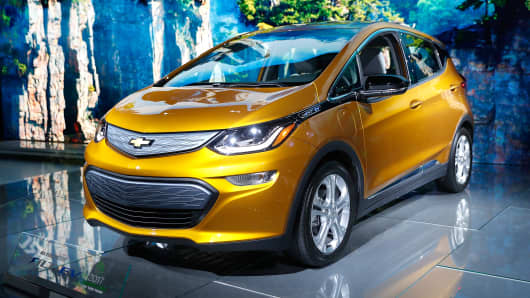
The Chevrolet Bolt EV is displayed during the Los Angeles Auto Show at the Los Angeles Convention Center on November 20, 2016 in Los Angeles, California.

Josh Lefkowitz | Getty Images

The Chevrolet Bolt EV is displayed during the Los Angeles Auto Show at the Los Angeles Convention Center on November 20, 2016 in Los Angeles, California.

A leading auto industry researcher has for the first time ranked four electrified powertrains among its list of the top 10 engines.

For the first time in its 24 years of existence, WardsAuto's Top Ten Engines List included one fully electric car, a hybrid, a plug-in hybrid and a hydrogen fuel cell car. That would mean four of the top 10 automotive engines for 2018 are not engines at all.

The fully electric Chevrolet Bolt, the plug-in hybrid Chrysler Pacifica, the hybrid Toyota Camry, and the hydrogen fuel cell Honda Clarity were all included in the list, which evaluates powertrains on cars priced below $50,000 that are for sale in the U.S. by the end of the first quarter in 2018.

The team did not set out to include so many electrified vehicles, WardsAuto senior content director Drew Winter told CNBC. The team focuses on engines or powertrains that add an exceptional degree of value of the car, and factor in practicality and value.

"There were a lot this year just because the industry is coming out with so many alternative powertrains that are really good," Winter said. "We are letting consumers know, you don't have to buy this because you have to or because you feel you should. It is really a part of the value proposition of the car."

Perhaps the least accessible car on the list for buyers is the Honda Clarity fuel cell car, which for now is only available in California. Hydrogen fueling infrastructure is severely limited to just a few regions of the country.

Despite that, it is a pretty strong value for customers who happen to be in an area where they are available, Winter said.

One well-known electrified powertrain missing from the list is the Tesla Model 3, which went into production in July and starts at $35,000. The team did not include the model because they could not get a car for testing. WardsAuto did not evaluate the Chevrolet Bolt in 2016 for a similar reason, Winter said.

One unusual note about this year's list is the total absence of any cars from German manufacturers, particularly the higher-end brands. Also unusual is that there were only two returning winners this year — the Chrysler Pacifica Hybrid and the Infiniti Q50. This was primarily due to sheer competition.

"Really what that tells us is that engine technology powertrain technology is really advancing fast now. There are just so many new propulsion systems.

Here is the full list of winners:

  • Chevrolet Bolt EV (150-kW Electric Propulsion System)
  • Chrysler Pacifica Hybrid (3.6L Pentastar DOHC V-6/PHEV)
  • Ford F-150 (2.7L Twin Turbo DOHC V-6)
  • Ford Mustang GT (5.0L DOHC V-8)
  • Honda Clarity (130-kW Fuel Cell/Electric Propulsion System)
  • Honda Civic Type R (2.0L VTEC Turbocharged DOHC 4-Cyl.)
  • Infiniti Q50 (3.0L Turbocharged DOHC V-6)
  • Jaguar XF (2.0L Turbocharged DOHC 4-Cyl.)
  • Kia Stinger (3.3L Turbocharged DOHC V-6)
  • Toyota Camry Hybrid (2.5L Atkinson DOHC 4-Cyl./HEV)

  • Source: Four electrified cars ranked among WardsAuto's 10 best engines for first time

    Wednesday, December 13, 2017

    Electric vehicle demand leads to skyrocketing number of lithium-ion battery factories around the world

    An artist's rendering of the Tesla Gigafactory

    Source: Tesla

    An artist's rendering of the Tesla Gigafactory

    The number of planned lithium-ion battery factories around the world is skyrocketing, according to a report from Benchmark Mineral Intelligence.

    There are 26 battery "megafactories" that are either in production and due to expand capacity or new operations due to be in production by 2021, Benchmark said in a blog post on Monday. Benchmark coined the term "megafactory" to describe factories that produce more than 1 gigawatt-hour of total capacity in a single year.

    Compare that with just three such plants planned or in production in 2014.

    It is important to note that not all of these planned factories could end up opening for production. But all of them have a pretty good chance of being built, Benchmark Mineral Intelligence analyst Caspar Rawles told CNBC on Monday.

    "Things change, but the reality is everyone on that list is a very serious player," Rawles said.

    The growth will be fueled by rising demand for electric vehicles, Rawls said. Sales of electric vehicles are expected to especially take off around 2022 or 2023. Several manufacturers are planning to release electric vehicle lineups between now and then.

    Benchmark expects total global lithium-ion demand of 500 gigawatt-hours by 2025, compared with just 85 GWh in 2016.

    Much of that will be in China, where air quality concerns have fueled a big push for electric vehicles. China dominates Benchmark's list, with 49 percent of total planned capacity.

    The European Union is in second place with 23 percent of total planned capacity, and the United States is in third with about 15 percent.

    However, Benchmark noted Tesla has said it plans to expand its Gigafactory, located in Nevada, eventually achieving a capacity of 150 GWh.

    Building the plants is only part of the challenge, though. The larger task may be securing access to the raw materials, the report said.

    For example, China controls 80 percent of the market in chemical cobalt, a crucial ingredient in lithium-ion batteries, he said.


    Source: Electric vehicle demand leads to skyrocketing number of lithium-ion battery factories around the world

    Tuesday, December 12, 2017

    Electric Car Battery Prices Could Be Cut in Half by 2025

    More companies are doubling down on EVs, and one of the benefits of any product becoming commonplace is that they become more affordable. That includes the lithium-ion batteries used to store power in nearly every electric car on the market today. As more cars are produced and manufacturing costs decrease, economists now believe that the cost of battery technology could be cut by more than half by 2025, Bloomberg reports.

    Just as a gasoline-powered car requires a fresh fill up of gas every so often, an electric car requires the owner to plug it in so that its battery cells can be recharged and power the electric motors that drive the car. Owners of EVs and the manufacturers producing them have quickly come to find out the sheer cost of batteries alone is quite high. Thanks to new technology and decreased manufacturing costs, however, batteries have gotten even cheaper, allowing manufacturers to drive down the price of electrified cars due to decreased product cost.

    Today, buying an electric car will cost a new owner around $209 per kilowatt-hour. This might seem like a lot, but with less cost coming from moving parts when compared to a typical gas-driven car, the cost of larger components such as a battery pack can seem warranted. Bloomberg researchers have been watching the cost of batteries since 2010, when the cost was nearly $1,000 per kWh, to a projected cost in 2025 where the same cost has the potential of decreasing to just $100. This aligns with the numbers reported by Wards, stating that key players at the Consumer Electronics Show in Las Vegas quoted $80 per kWh "not long after" 2020.

    For example, at current prices, a car with a 100 kWh battery pack may cost the consumer an average of $20,900 for the battery pack alone. Granted, currently these high-capacity battery packs are reserved for luxury vehicles like the Tesla Model S. However other manufacturers like Volkswagen and Volvo have planned to put battery packs sized similarly or larger into their electric vehicles. Potentially, this cost will be reduced by around 53 percent, falling to $10,000 by 2025.

    This is, of course, assuming that other solid-state offerings in the industry don't take over first. Companies such as Fisker and Toyota are working toward developing graphene-based supercapacitors which could potentially upset the very usability of lithium-ion batteries as a whole.

    Now, as manufacturers race to cut the bottom-dollar cost of mass-produced electric cars, it becomes a fight not for horsepower, but for range. We all know that electric cars can be full of torque and feel absolutely quick, and new technology hopes to prolong that feeling of a revolutionary platform. Fortunately, as platform prices decrease, it becomes possible to fit even more game-changing tech into a single car without raising the price.


    Source: Electric Car Battery Prices Could Be Cut in Half by 2025

    Monday, December 11, 2017

    The number of electrical car charging stations is rising, but does that mean wider adoption of electrical cars will follow?

    By Dan Boyce

    December 11, 2017 | 12:18 PM

    Embed Code <iframe src="https://www.marketplace.org/2017/12/11/business/electric-car-range-anxiety/popout" frameborder="0" width="100%" height="240px"></iframe> A new electric vehicle charging station is seen near San Francisco city hall. Will the proliferation of charging stations lead to more electric cars in the West?A new electric vehicle charging station is seen n ear San Francisco city hall. Will the proliferation of charging stations lead to more electric cars in the West? - Justin Sullivan / Getty Images Embed Code <iframe src="https://www.marketplace.org/2017/12/11/business/electric-car-range-anxiety/popout" frameborder="0" width="100%" height="240px"></iframe>
    A recent ribbon cutting in downtown Denver gave a snapshot of electric vehicle charging in the U.S.

    The event, dubbed "Ride into the Future," brought in several car companies with EVs for people to test drive around the block. There were electric bikes too. But, the real highlight was the unveiling of the first electric car fast charger in Denver's LoDo neighborhood.

    While there are already more than 150 charges citywide, Cindy Patton, who runs parking and mobility services for the City of Denver, said the new installation is a win against climate change. 

    "Milestones like this celebration today really are benchmarks in that fight, in that pursuit," she said.

    But all the fuss is really to launch the equivalent of a single gas pump.

    The American West is known for its wide open spaces. Those open spaces can make for some pretty epic road trips, unless, that is, you have an electric vehicle and you're stuck hours away from a charge.

    At the National Governor's Association Energy Innovation Summit in Denver this fall, Colorado Governor John Hickenlooper announced a plan to put electric vehicle charging stations along Interstate highways in seven Western states — as a way to combat this so-called "range anxiety."

    "We're gonna start out at every 50 miles," Hickenlooper said, "so that people, no matter where they're driving can feel pretty comfortable that they're not gonna run out of fuel, as it were."

    Officials expect the highway charging stations, dubbed the Intermountain West Electric Vehicle Corridor, to be up and running in three to five years.  

    Sales of EVs are climbing and some forecasters predict half of the vehicles sold worldwide will be electric by 2040. But, in present day, a lack of charging stations is still holding back this transportation revolution.

    "The whole network of user experience issues are something that continue to somewhat inhibit adoption, widespread adoption of electric vehicles," said Sam Ori, executive director of the University of Chicago's Energy Policy Institute.

    The western charging network adds to an increasing list of efforts by governments and industry to improve EV infrastructure. Companies are producing faster chargers and entering into deals with the likes of grocery chains and hotels. Even oil giant Royal Dutch Shell recently announced a plan to install charging stations at its gas stations in the U.K.

    While, of course, more chargers will help allay drivers' range anxiety over time, Ori said it's not the biggest factor holding back EV sales. Even if chargers were everywhere, gasoline vehicles are still just a better financial deal, especially with oil prices where they are now. Incentives already exist for buying electric cars in many states, yet Ori said without serious policy penalizing carbon emissions — like with higher gas taxes — EVs will remain at a disadvantage for a long time.

    Until then, Ori said the EV market will be largely confined to those who care more about environmental action than whether or not they break even over the life of the vehicle. This includes himself. Ori owns an electric car, and said it wasn't necessarily the best economic move.

    "But, it wasn't why I wanted to buy the car," he said. "I wanted to drive it for different reasons, but I don't think that is a pathway to mass adoption."

    Even if there are a lot more ribbon cuttings for new charging stations. 


    Source: The number of electrical car charging stations is rising, but does that mean wider adoption of electrical cars will follow?

    Sunday, December 10, 2017

    Electric Cars in 2025 and 2040: New Policies

  • According to the IEA's "New Policies Scenario," there would only be 280 million electric passenger cars on roads worldwide by 2040.
  • According to the IEA, electric cars will account for only 14% of the global passenger fleet of about 2 billion in 2040.
  • 1. The International Energy Agency has multiple projections for future climate change policies and energy-related markets.

    2. Their moderate forecast is called the "New Policies Scenario." Under it, there would only be 280 million electric passenger cars on roads worldwide by 2040.

    3. Electric cars would thus account for only 14% of the global passenger fleet of about 2 billion in 2040.

    Electric Cars: A "Just The Facts" Series

    Electric Cars: How Many Today Worldwide?

    Electric Cars in 2040: Sustainable Development

    Electric Cars in 2025 and 2040: New Policies

    Emissions Control and Electric Cars in 2020

    4. In that scenario, overall oil demand for cars would be lower by only 1.3 million barrels per day in 2040 than today – or 6% less.

    5. By then, in China – already today the world's largest car market – one in four passenger cars would be electric.

    6. Over a shorter timetable, i.e. by 2025, less than a decade from now, the IEA projects there will be 50 million electric cars.

    7. Broadly speaking, that would mean 5.3 million new cars a year would need to be electric.

    8. The IEA assumes in the moderate "New Policies Scenario" that the unsubsidized cost for a fully-electric car's battery will probably only decline by about half from 2015 to 2040.

    9. The average battery costs in 2016 were less than $260 per kilowatt-hour (kWh) for plug-in electric hybrids and an estimated $200/kWh for fully electric cars.

    10. That means a fully-electric car battery might cost around $12,000, although the price is declining.

    Sources: The Globalist Research Center and the International Energy Agency


    Source: Electric Cars in 2025 and 2040: New Policies

    Friday, December 8, 2017

    Volvo XC60 road test, Jaguar skipping V-8s, Volkswagen ID electric car: What’s New @ The Car Connection

    2018 Volvo XC60 video road test

    Volvo builds sublime sedans and wagons, but these days, it's best known for its SUVs. The big XC90 has been a knockout, and there's a new, tough-looking XC40 compact crossover coming soon.

    Uber investor pumps $500 million into Lyft

    First, it was Uber's misfortunes helping to accelerate arch-rival Lyft's growth. Now it's Uber's fortunes. Mutual fund Fidelity will take part in Lyft's newest round of financing, in which the company is expected to raise $1.5 billion overall.

    Roundup: All the 2018 IIHS Top Safety Pick+ winners

    The insurance industry-funded IIHS says that these are the safest cars you can buy today—they're the ones that qualify for its coveted Top Safety Pick+ award.

    From Motor Authority

    2019 Volvo XC40 first drive review: fountains of hope, and crossover SUV potential

    Shooting through the streets of Barcelona behind the wheel of the 2019 Volvo XC40 is doubly appropriate. 

    Jaguar isn't planning a V-8 for XE or XF

    Well, color us a shade of bummed. After long speculation, Jaguar confirmed we won't see a V-8 engine under the hood of the XE or XF anytime soon. Save for the wild XE SV Project 8, of course.

    Ford to build electric SUV in Mexico instead of Michigan

    Ford in 2015 outlined plans for 13 new electrified cars to be launched by 2020, one of which will be an electric SUV with a range of 300 miles.

    From Green Car Reports

    Volkswagen ID electric car production date now set: November 2019

    Since the Dieselgate scandal broke more than two years ago, Volkswagen has spent a great deal of time talking about its plans for electric cars.

    VW Dieselgate exec Schmidt gets maximum jail sentence: 7 years

    A Volkswagen manager who pleaded guilty to deceiving regulators in the United States over the emissions of the company's TDI diesel engines has been sentenced to the maximum penalty of seven years in prison and the maximum fine of $400,000.

    Plug-in electric car sales in Canada, Nov 2017: the vaulting Chevy Volt

    A record 582 Chevrolet Volt plug-in hybrids were sold in Canada last month, two months after Chevy delivered a then-record 483 Volts in September.


    Source: Volvo XC60 road test, Jaguar skipping V-8s, Volkswagen ID electric car: What's New @ The Car Connection

    Thursday, December 7, 2017

    Volkswagen ID electric car production date now set: November 2019

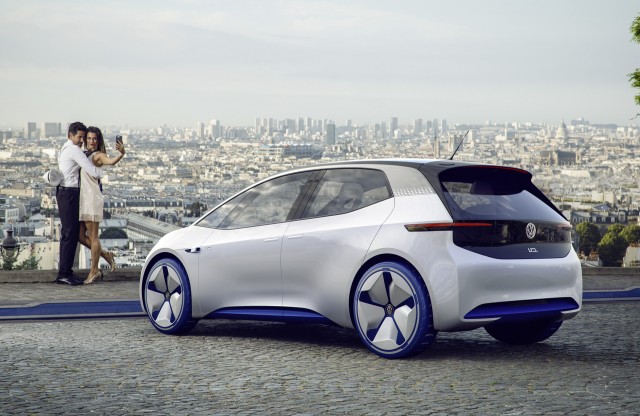
    Volkswagen ID electric car concept, 2016 Paris auto show

    Volkswagen ID electric car concept, 2016 Paris auto show

    Enlarge Photo

    Since the Dieselgate scandal broke more than two years ago, Volkswagen has spent a great deal of time talking about its plans for electric cars.

    It has rolled out three concept vehicles within the new Volkswagen ID family, and discussed its dedicated electric-car architecture that will underpin all of them.

    Now, the company has committed to a date for producing its first high-volume dedicated battery-electric car.

    DON'T MISS:

    In a release last Friday, Volkswagen said it is 100 weeks away from the first production of the Volkswagen ID five-door electric hatchback.

    That car, the first in the ID lineup, was unveiled at the 2016 Paris Motor Show, and will be its highest-volume electric car in Europe.

    Volkswagen made its announcement to mark the "MEB Supplier Summit" event, a meeting of the various companies providing components and assemblies for the vehicles to be built on its new MEB electric-car architecture.

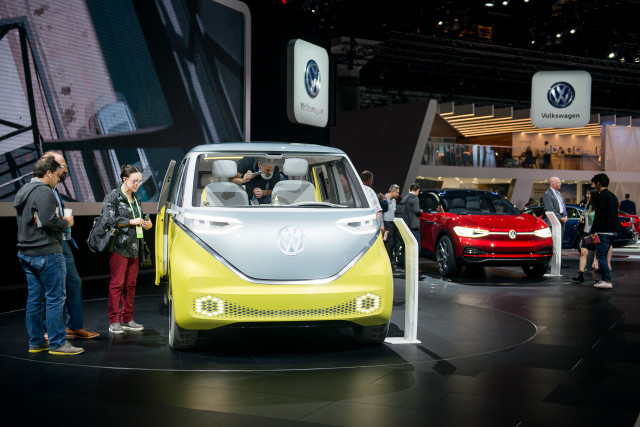
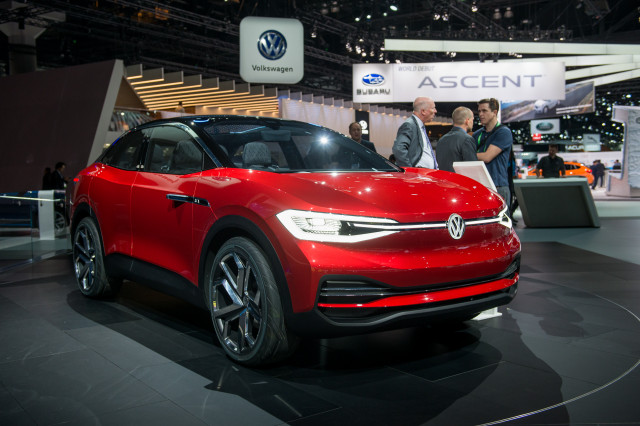
    Volkswagen ID Crozz concept, 2017 Los Angeles auto show

    Volkswagen ID Crozz concept, 2017 Los Angeles auto show

    Enlarge Photo Volkswagen ID Buzz and ID Crozz concept, 2017 Los Angeles auto show

    Volkswagen ID Buzz and ID Crozz concept, 2017 Los Angeles auto show

    Enlarge Photo

    One hundred weeks from last Friday puts the start of production sometime in November 2019. So now the company has a firm commitment to a date.

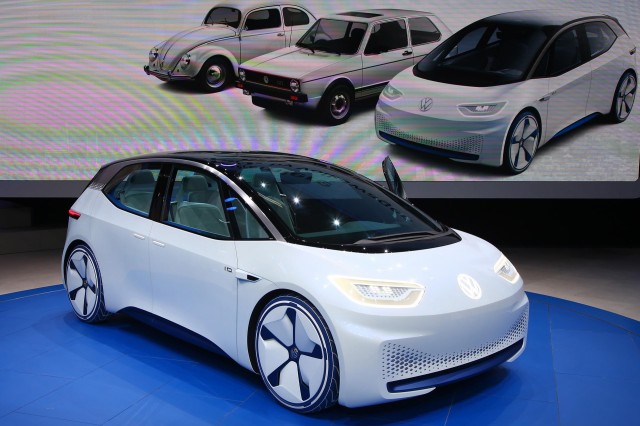
    The Golf-sized compact Volkswagen ID hatchback is said to have the interior volume of a mid-size sedan like the Volkswagen Passat.

    Its 125-kilowatt (168-horsepower) motor is mounted in the rear, under the load bay, which gives the car's designers far more flexibility in design, permitting a shorter and lower nose and more interior volume.

    READ THIS: VW ID Buzz driven: electric VW bus offers unique EV concept

    Volkswagen hasn't specified a final battery capacity for the ID, but it is expected to be around 60 kilowatt-hours, or large enough to deliver real-world range of 200 miles or more.

    The ID hatchback won't be sold in North America, however, or at least not initially.

    The first of the Volkswagen-branded electric cars to go on sale in the U.S. will be the VW ID Crozz compact crossover in 2020, as the company announced at last week's Los Angeles auto show.

    Volkswagen ID electric car concept, 2016 Paris auto show

    Volkswagen ID electric car concept, 2016 Paris auto show

    Enlarge Photo

    That will be followed by an as-yet unnamed electric sedan that hasn't yet been shown as a concept.

    Then will come the Volkswagen ID Buzz, the wildly popular all-electric reinterpretation of the classic VW Microbus. That concept debuted in January at the Detroit auto show.

    CHECK OUT: Volkswagen ID: more details of all-electric concept car at Paris Motor Show (Sep 2016)

    Volkswagen announced in August the ID Buzz would go into production in 2022 as a joint project with its commercial vehicles division, which will likely offer panel-van, pickup, and other utility versions of the electric bus.

    But the Volkswagen ID hatchback targets Europe's most popular vehicle class: so-called C-segment, or compact, five-door hatchbacks.

    _______________________________________

    Follow GreenCarReports on Facebook and Twitter.


    Source: Volkswagen ID electric car production date now set: November 2019